
Afghan Biographies
- Name:
Mining sites of interest
- Ethnic:
- Date of birth:
- Function/Grade:
- Precious stones Gemstones
- History and Biodata:
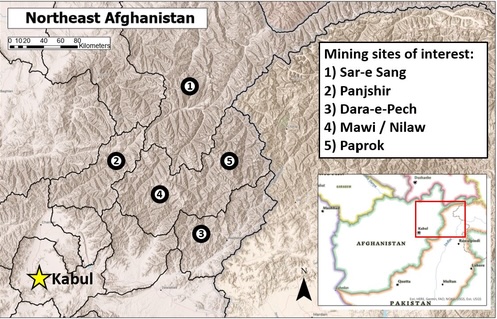 Sar-i Sang (or Sar-e Sang) (lit. "stone summit" in Persian) is a settlement in the Kuran Wa Munjan District of Badakhshan Province, Afghanistan, famous for its ancient lapis lazuli mines producing the world's finest lapis, It is located in the Koksha Valley. Badakhshan Province, Afghanistan
Geo: 36.211, 70.801
Elevation: settlement at 2400 meters, mining sites at 2500-2750 meters.
Mining season: June to November, though may be longer if there are warmer temperatures
Production: Lapis Lazuli
The Panjshir Valley has the potential to become a major centre of emerald mining. As early as the 1st century AD, Pliny the Elder commented on gemstones from the region. In the Middle Ages, Panjshir was famed for its silver mining and the Saffarids and Samanids minted their coins there.As of 1985, emeralds upwards of 190 carats (38 g) had been found in Panjshir, reported to rival in quality the finest crystals of the Muzo mine in Colombia. The villages of Khenj and Mikeni were "boomtowns" that supplied the labor for mining in the nearby mountains. With the new Taliban rule as of fall 2021, dynamite for mining was no longer legal for purchase which makes mining more difficult.
Panjshir Province, Afghanistan
Geo: approximately 35.42839, 69.8072, running northeast and southwest on the east side of the Panjshir river
Elevation: settlements at 2200-2450 meters, mining sites at 2750-3000 meters.
Mining season: May – October for higher elevations, longer at lower elevations
Production: EmeraldsDara-e-Pech
Kunar Province, Afghanistan
Geo: 34.952, 70.818
Elevation: 1200 meters
Mining season: Year-round
Production: Spodumene (Kunzite), Morganite, Tourmaline
Tourmaline and kunzite were first found in the hills of the Pech Valley in 1959 and soon locals were collecting the crystals and selling them in street markets in Kabul. In the mid-1980s, specimens from the area started showing up in European and American mineral shows and began entering collections.Some of the finer specimens from the site sell in the four-to-five-figure range to collectors with one of the finer specimens valued at $250,000.In 2013, political instability slowed mining down in the area. However, in 2015, the government claimed all mining rights.
Mawi
Nuristan Province, Afghanistan
Geo: main Mawi mine at 35.201,70.335, Kolum mines toward the northeast at 35.20789, 70.34902
Elevation: 2000 meters
Mining season: likely year-round
Production: spodumene (kunzite), morganite, tourmaline
Approximately 1.5 kilometers away from Mawi is another site called the Kolum pegmatite which also yields various crystals for collectors.
Nilaw
Nuristan Province, Afghanistan
Geo: 35.23677, 70.28785
Elevation: 2500 meters.
Mining season: during warm seasons
Production: tourmaline and others
Paprok (Papruk Mine; Paprowk Mine)
Nuristan Province, Afghanistan
Geo: 35.62354, 71.16068
Elevation: 4400 – 4600 meters
Mining season: September to November or between snow season
Production: tourmaline
The locality often refered to as the Paprok mine consist of several workings in pegmatites on the right side of the Kéhi Dara Valley, south of the Paprok village. The main workings are the Me Tunnel Madan, KAL Tunnel Madan, GUL Tunnel Madan and Al Madan. (Madan = mine or working). Gem-bearing spodumene pegmatites, hosted in Late Triassic slate. (Lyckberg 2011)
Critical Intelligence Questions as of 20250807
- What is the current status of activity in mining areas?
- Has mining activity increased, decreased, or stayed the same?
- What changes in local infrastructure can be observed?
- What changes in the population of local villages can be observed?
- What evidence of increased military activity can be detected near the sites?
- What indications of recently mined material making its way to global markets can be detected through social media, open reporting, or other sources?
- Last modified:
- 06 August 2025
- Established:
- 06 August 2025