
Afghan Biographies
- Name:
Maulana Fazlur Rehman Khalil
- Ethnic:
- Pashtun
- Date of birth:
- 1953
- Function/Grade:
- Pakistani Taliban Supporter
- History and Biodata:
3. Biodata:
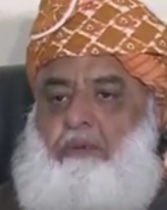 Maulana Fazlur Rehman Khalil son of Mufti Mahmud was born 1953 in the village of Abdul Khel in Dera Ismail Khan, Pakistan. His early education was from a High School in Multan, where he was a student of Mussarat Baig and Syed Iqbal Shah.He attained a Bachelor's degree in 1983 from University of Peshawar and completed his Master's degree at Al-Azhar University in Cairo.During his early religious training and education in arabic grammar and Islamic logic he remained the disciple of Mufti Muhammad Essa Gurmani and Molana Abdul Ghaffor Gurmani of Shadan Lund, later studying Sharah-e-Mata-e-Aamil and Hidayat-un-Nahv with Muhammad Ameer of Chudwan in a madrassa in Multan.He was a student of Abdul Haq Akorwi, Hasan Jan, and Syed Sher Ali Shah during his Shahadat-ul Alamia at Darul Uloom Haqqania, and subsequently completed his Dars-i Nizami with distinction in 1979
Fazal-ur-Rehman is a strong Taliban supporter, known for his close ties to the Islamic Emirate of Afghanistan.He has called for imposition of Sharia in Pakistan and is regarded by some as an extremist, though he has tried to re-brand himself as moderate.Being a follower of Mahmud Hasan Deobandi who campaigned for liberation against the British Raj but later restricted his members from armed struggle after establishing a political party, Rehman opposed armed struggle to impose sharia laws as it leads to extremism in society.When in power in Khyber Pakhtunkhwa from 2004 to 2007, his party passed the 'Hasba Bill' which was later declared illegal and unconstitutional.Through this bill, he believed that he would be following in his father Mufti Mahmud's footsteps, as he tried to implement 'Nizam-e-Mustafa', which his father struggled for throughout his political life. However, it was declared unconstitutional by Chief Justice of Pakistan Iftikhar Chaudhry.After defeat in the 2018 Pakistani general election, Rehman was ejected from the National Assembly and failed to win major political support in Khyber Pakhtunkhwa, winning 10 of the 99 seats in his home turf. Alleging election fraud, 11 opposition political parties formed the PDM appointing Rehman as the president of this movement.
He is a Pakistani Islamic scholar and politician, who serves as the president of Jamiat Ulema-e-Islam (F). He is also a member of the National Assembly since February 2024 and had previously served in that position between 1988 and 2018.
He recently has launched a political front in Pakistan, and he has worked in assisting the government’s de-radicalization drives through his famed Deobandi madrasa (religious seminary) Jamia Khalid bin al-Waleed, as well as issuing and supporting pro-government fatwas (religious diktats) denouncing militant violence in Pakistan.
He runs the Jamia Khalid Bin Walid, a Islamic seminary located in Islamabad’s Golra district town which has been accused of supporting the Tehrik-i-Taliban Pakistan.
More Background:Fazlur Rehman Khalil, a veteran of Afghan and Kashmir jihad movements, co-founded Harakat-ul-Jihad-ul-Islami (HuJI) in 1980 with two other renowned militant personalities, Irshad Ahmad and Qari Saifullah Akhtar.
Fazlur Rehman Khalil studied in Karachi’s Jamia Uloom-ul-Islamia, located in Binori Town. Presently, he is based in Rawalpindi, the Pakistani garrison city adjacent to the capital Islamabad. A known religious cleric and Islamic scholar, Fazlur Rehman Khalil was a signatory of Osama bin Laden’s February 1998 fatwa against Israel and the West, the “International Islamic Front for Jihad against Jews and Crusaders” (IIF). Though he was wrongly named in the media as one of the five original signatories, Khalil came into the IIF later, after a U.S. cruise missile attack killed many HuM militants in an al-Qaeda training camp in Khost, Afghanistan, in August 1998. His name was often confused with another original signatory, Fazlur Rehman, the Amir of the jihadist movement in Bangladesh. The Khost bombing prompted Khalil to vow revenge against America.
Khalil was listed as a Specially Designated Global Terrorist by the U.S. Department of Treasury in September 2014. However, even earlier, his organizations, such as HuM and Ansar-ul-Umma (AU), came under scrutiny and proscription in Pakistan and elsewhere (e.g. the United States and India). HuM was first listed as a foreign terrorist organization by the U.S. Department of State in 1997. After HuM’s ban, Khalil renamed the group as Ansarul Ummah, claiming that the new group was engaged in religious preaching, politics and social-humanitarian services, albeit in an effort to avoid international sanctions. Despite this rebranding, then-Pakistani President General Pervez Musharraf banned HuM in January 2002. In mid-2014, the United States also classified Ansarul Ummah as an HuM front organization. Though both Khalil and his AU openly operate in Pakistan, raising funds and recruiting youths for jihad, neighboring India banned AU under its Unlawful Activities (Prevention) Act in April 2015 (Economic Times, April 13, 2015).
After his designation as a global terrorist in 2014, Fazlur Rehman Khalil vehemently rejected the ban, openly challenging the decision as “unjust” and blaming it on his support for the Palestinian cause. He was quoted at the time as saying that he and his organizations had “never been involved in terrorism,” and were instead “Islamic Mujahideen” (Express Tribune, October 2, 2014).
After the formation of HuM under Khalil’s leadership, the group’s jihadist activities were undertaken in Afghanistan. Khali had successfully forged links with Maulvi Yunus Khalis of Hizb- e-Islami and played important role in supplying manpower and raising funds for the Afghan jihad in the 1980s. As the U.S. Department of Treasury noted, in his capacity as HuM emir, Khalil wielded immense control over HuM’s overall affairs, including financial decisions. He even traveled to the Middle East for donations for HuM operations.
Khalil once stated candidly: “I have fought with the Americans in Afghanistan […] But I haven’t gone to Kashmir for a single day” (New Indian Express, March 29; Associated Press, March 29).
After the Soviet withdrawal from Afghanistan, HuM shifted its focus to the Kashmir theater as part of the Pakistani military’s grand strategy to relocate its proxies. As with HuM, other Pakistani-sponsored militant groups began to call for Kashmir’s secession from India and its accession to Pakistan. With a pan-Islamic ideology, HuM, with all its formations and its leader Fazlur Rehman Khalil, has remained steadfast in its efforts to achieve the secession of Jammu and Kashmir from India through violence. Even today, Khalil has been a regular in pro-Kashmir rallies across the country along with likeminded religious extremist groups and leaders (e.g. Ahle Sunnat Wal Jamat, Jamiat Ulema Islam and Jammat ud Dawa) that the Pakistani establishment has supported for several decades. Khalil openly states that “Jihad is the only way to liberate Kashmir from Indian occupation.” He once, during a Kashmir rally in Islamabad in 2016, even urged the Pakistani government to cut off diplomatic and trade ties with India (The Fortress, July 15, 2016).
Khalil and his trusted commanders in the Harkat Triad were blamed for two major militant operations against India in the 1990s, as well as for many other violent attacks targeting India. His group was suspected to be behind the 1995 hostage crisis in Kashmir. A front group, al-Faran, took six foreigners hostage to negotiate the release of Pakistani terrorists in Indian prisons. When the Indian government refused to accept their demands, the abductors killed the hostages (Express Tribune, June 25, 2011). In December 1999,
HuM leaders in Pakistan masterminded the hijacking of Indian Airlines Flight IC 814, which they used to leverage the release of several high-profile militants—Maulana Masood Azhar, Ahmed Omar Saeed Sheikh and Mushtak Ahmed Zargar (Rediff.com, December 28, 2004). Included in the release was Khalil’s protégé, Masood Azhar, who went on to establish his own militant group, Jaish-e-Muhammed, in early 2000. However, in February of that year, Fazlur Rehman Khalil reportedly stepped down as HuM leader. His fellow militant Farooq Kashmiri took over the reins of HuM and Kashmir operations.
HuM has operated training camps in Muzaffarabad, in Pakistan Administered Kashmir, Rawalpindi and several other locations in Pakistan, especially in the border regions of Pakistan and Afghanistan. It once had a robust presence Kashmir’s Srinagar, Budgam, Pulwama, Baramullah and Rajouri districts. Khalil reportedly personally supervised camps and madrasas located in Pakistan’s territory (India TV News/ Press Trust of India, June 16, 2011).
In addition to the attacks on Indian soil, a HuM faction, HuM-Al Alami, and its leadership are linked to several notable terrorist events in Pakistan—most notably the June 2002 attack on the U.S. Consulate in Karachi that killed 11 people and the abduction and murder of Wall Street Journal reporter Daniel Pearl in January 2002. Omar Saeed Sheikh, who was released by the Indian authorities in exchange for hostages in December 1999, masterminded Pearl’s abduction and killing.
While evidence of Fazlur Rehman Khalil’s direct role in many of these events remains tenuous, his fellow militant followers carried them out under his watch and influence. After 9/11, Khalil maintained a low profile as secretary general of HuM. With his considerable clout intact even after he stepped down from his active role within HuM, he activated his networks and influence to support the Taliban and al-Qaeda in the wake of the U.S. military operations in Afghanistan. Khalil openly recruited and sent militants to Afghanistan in the name of “Holy War” to fight along with the Taliban.
In May 2004, Khalil was arrested and detained for a few months for sending Pakistani militants into the Afghan war zones (Pakistan Herald, October 13, 2014). Though initially under pressure by the Musharraf government due to U.S. pressure, the government used Khalil, and his considerable stature among other militant groups, in negotiations over the Lal Masjid (Red Mosque, Islamabad) standoff in July 2007. He was one of the few clerics appointed by the Musharraf government to negotiate with the militants and their leaders before the military stormed the mosque (The News, July 10, 2007). Again, in October 2009, the Pakistani government asked for Khalil’s help— along with other pro-Pakistan militant leaders—to hold talks with the militants who had stormed the Pakistan Army’s General Headquarters (GHQ) in Rawalpindi and had taken many hostages (The Nation, October 12, 2009; Rediff.com, October 16, 2009).
Like Jamaat-ud-Dawa (JuD) and its leadership who entered the mainstream, dabbling in social welfare and humanitarian activities, Maulana Fazlur Rehman Khalil too has jumped into the political sphere with the proposed launch of the Islah-e-Watan Party (IWP) (Pakistan Today, August 25, 2017). According to Khalil, the IWP will work to promote peace and tranquility in the country, to mobilize the masses against corruption and to raise issues like the government’s failure to meet people’s basic needs—like food and water, shelter, access to affordable healthcare. His political posturing also uses anti-U.S. rhetoric aimed at harnessing popular sentiment in Pakistan. Khalil once criticized U.S. President Donald Trump and threatened to make Pakistan into a “graveyard” for aggressive (U.S.) forces (Pakistan Today, August 25, 2017). This was not the first occasion when Khalil threatened U.S. forces. In 1998, Khalil publicly issued a warning against the United States at a news conference. He said, “For each of us killed or wounded in the cowardly U.S. attack, at least 100 Americans will be killed. I may not be alive, but you will remember my words” (The News, October 4, 2014).
It should be noted that Khalil was a major voice against NATO forces routing supplies to Afghanistan through Pakistan. He used the Difa-e-Pakistan Council, an umbrella group of anti-India and anti-U.S./NATO political and religious parties, to put pressure on the Pakistani government against any facilitation of NATO, the United States or India (The Express Tribune, May 06, 2012).
- Last modified:
- 11 March 2026
- Established:
- 11 March 2026